I've started reading A Farewell to Alms, a book about the economic history and macrosociology of the last two thousand years. It received an enthusiastic write-up in the New York Times (here), and I think its publication date might have been accelerated as a result.
The moral and political implications of the book's argument, either if it is true or if it comes to be regarded as true, are so breathtaking as to be hard to understate, especially in a hastily written blog post by someone who is moving.
The argument, most briefly, is that part of what led to the Industrial Revolution was a more longstanding improvement of the species over the preceding several hundred years, and, although the book is coy about saying this improvement could be either "cultural" or "genetic," it's clear that author's inclination is "genetic." The seemingly obvious implication if that were true--although I am uncertain from the 30-odd pages I've read so far whether the author will actually connect the dots he draws right there on the page--is genetic variation among people with ancestry from different parts of the world on traits pertinent to socioeconomic attainment. Good to have ancestry from the regions of the world that were the leaders of the Industrial Revolution or otherwise socially close to it, and bad to be from regions that were not close. In this respect, the argument could be interpreted as providing the historical backstory for The Bell Curve. So, it's important, especially given that it is by an economist and all the recent hoopla for economics as the enterprise that has the apparatus to uncover hidden insights into social affairs and the independent-mindedness to speak unpopular "truths."
As I said, I haven't read enough of the book to be able to begin to evaluate its evidence, and moving isn't exactly allowing great focused cognitive space for reading. I'm approaching the book with a lot more skepticism than the author of the NYT article. I know I post perhaps surprisingly little about the substance of social science on this blog, but it doesn't get more substantive than the history of human organization and the causes of social inequalities, so I'm putting y'all on alert about this book if you haven't heard about it.
Showing posts with label economics. Show all posts
Showing posts with label economics. Show all posts
Friday, August 31, 2007


Thursday, August 23, 2007
a better title might have been: re-discover your inner economist
I read the first six chapters of Discover Your Inner Economist by the economist and popular blogger Tyler Cowen today. I don't read his blog, but given how much people enjoy it, I was expecting the book to be better. Indeed, I kept reading despite not feeling I was getting much out of it because I kept presuming it would get better. It didn't.
While reading it, I was reminded of the line in Ghost World where Enid says some kitsch performer has gone from being "Past being so bad it's good to being bad again." In this case, one of the main parts of book's overall argument is to go past being counterintuitive to where it is intuitive again. Earlier popular economics writers like Steven Landsburg have created a stage in which another economist talking about how much of the world of interpersonal relationships and intrapersonal striving is not, in fact, like buying bananas at the supermarket can be called channeling one's Inner Economist, instead of, well, one's Humanity. That is, sometimes Cowen is arguing to a popular audience against standard economics and more toward the view the popular audience would have if it hadn't paid attention to some of the excesses of standard economics in the first place.
Apparently also, if you have a Ph.D. in economics, you can give whatever life advice and theories about human nature that you have and pass it off as manifesting economic expertise. Much of the book is about Cowen's vague ideas about the human need for "control." The last anecdote that made me decide I couldn't justify spending any more time with the book began:
* This column by Landsburg in Slate singlehandedly stunted my growing interest in economics for almost a year, by making an enterprise that I was coming to better appreciate suddenly seem ludicrous (the stunting abated when I realized that Landsburg was not the ambassador of mainstream economics he presents himself as being).
While reading it, I was reminded of the line in Ghost World where Enid says some kitsch performer has gone from being "Past being so bad it's good to being bad again." In this case, one of the main parts of book's overall argument is to go past being counterintuitive to where it is intuitive again. Earlier popular economics writers like Steven Landsburg have created a stage in which another economist talking about how much of the world of interpersonal relationships and intrapersonal striving is not, in fact, like buying bananas at the supermarket can be called channeling one's Inner Economist, instead of, well, one's Humanity. That is, sometimes Cowen is arguing to a popular audience against standard economics and more toward the view the popular audience would have if it hadn't paid attention to some of the excesses of standard economics in the first place.
Apparently also, if you have a Ph.D. in economics, you can give whatever life advice and theories about human nature that you have and pass it off as manifesting economic expertise. Much of the book is about Cowen's vague ideas about the human need for "control." The last anecdote that made me decide I couldn't justify spending any more time with the book began:
On a more personal level, a willingness to give up control can make us better teachers. When we teach our children how to drive, we like to pretend they will never do anything stupid. We give them a lecture about the long list of things they should never do.Some people might find these expositions more interesting or amusing than I did, but they also provoked this recurrent sense that we were straying far for a book that said it was going to be about incentives. He has this whole chapter about how to appreciate art better, parts of which were interesting, but even then I kept wondering how particular points were "economic." It's as if anything that evinces wisdom in a social setting is to be understood as channeling your Inner Economist.
My approach is different. I taught Yana, my then-fifteen-year-old stepdaughter, how to drive. One day I started with: "The first thing we are going to do is hit the curb. Drive over the curb, just not too fast." This is the best way to learn where the curb is. Yana is going to find the curb anyway, sooner or later, so let this learning occur under safe circumstances.
* This column by Landsburg in Slate singlehandedly stunted my growing interest in economics for almost a year, by making an enterprise that I was coming to better appreciate suddenly seem ludicrous (the stunting abated when I realized that Landsburg was not the ambassador of mainstream economics he presents himself as being).
Monday, August 06, 2007
it has always seemed to me that one of the main things that would be fun about having two kids is getting to do experiments on them
Robert Frank, Falling Behind, page 54:
I came to this view in part because of an experiment I did years ago with my two oldest sons when they were five and seven years old. The experiment took three days. On day one, I poured each of them a full glass of orange juice. On day two, I poured each only half a glass. Then, on day three, I poured David (then age seven) seven-eighths of a glass and Jason (then age five) only three-quarters of a glass. (I am not sure that a human subjects committee would approve this experiment today.)
You can guess what happened. On the first two days, each drank his juice without comment. In particular, neither asked on day two why he'd gotten only half as much as the day before. But things played out differently on day three. Jason looked first at his own glass, then over at his brother's, then back at his own, his face registering growing signs of distress. It was obvious that he was struggling not to react. But finally he blurted out, "That's not fair; he always gets more than me."
Saturday, May 12, 2007
video killed the ratio star
Check out Chris's post about the Harvard Economics Department's graduate recruitment video and associated parodies. I was maybe thirty seconds into the real video before I realized that it was not, itself, some kind of joke ("Whoa, they really found someone who looks like Ed Glaeser... Wait, that really is Ed Glaeser, you wouldn't think he would have such a spectacular ironic sense of humor... Wait, this isn't supposed to be funny.")
Thursday, March 29, 2007
freaks and geeks
I uploaded a recent article in the New Republic on Freakonomics and economists fretting about the rise of cute little studies in their discipline. My stance, which I did not do an especially good job of articulating in this panel of Freaknomics at the Eastern Sociological Society meetings, is that sociology should, at least from a strategic standpoint, be on the side of the freakonomists in their battle against the structural-modellers in economics, because the former stakes out a position that is far more congenial to prevailing tendency of sociologists to be stronger with understanding data and process than they are at math.
Update: Link fixed.
Saturday, March 17, 2007
so, how was the conference?
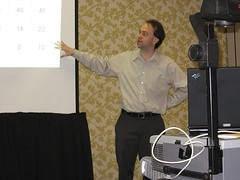
(me, presenting at the Eastern Sociological Society meetings)
The most common problem with giving talks at conferences is that one doesn't actually get an audience, and one is left talking almost or entirely only to the other panelists.* This leads one to feel like presenting is pointless, that one is producing a good no one else is actually interested in consuming, and various related issues that cause existential and morale crises in academics. Alternatively, one can sometimes get good attendance at a talk, but then one is dealing with this stochastic process where each additional person at a talk increases the probability that someone in the audience will be a crank or twit that provides some kind of irksome distraction that is then does much to decrease the value of the session.**
At the Eastern meetings, I gave two presentations: one fell into the first category above, and one--the panel on Freakonomics--fell into the second. The main session vandal for the second was this guy who was apparently the spouse of a sociologist, but I somehow missed this and spent much of the time when he would talk thinking, "How can this guy be a sociologist and know so little about social science?" Anyway, fellow sociologists: if you want to bring your spouse (or child, or pet) along to a presentation, that's fine, but just like if you were going to a restaurant or movie theater, try to have them behave. If he is doing things like interrupting other audience member's points with asides where everyone is supposed to raise their hand if they've read Freaknonomics, that's not behaving.
Another person in the audience wanted the panel to discuss whether Freakonomics was "the son of the Bell Curve," which I regarded as being too beyond ridiculous to know how to address and yet seemed to resonate with some other people in the audience. I suppose maybe I should consider it a victory that no analogies to the Nazis were drawn.
* I haven't had this problem with any panels I've been on, but one consequence of the rise of internet in hotels is that one can't necessarily even count on the attention of fellow panelists.
** One may be more likely at ill attended talks to be on a panel with someone who is a crank or twit and does much to compromise the panel for everyone, especially if they go on for twice their allotted time with a presider who just lets them.
Monday, February 26, 2007
let's be clear: your discarded do-si-dos are not doing the underclass any favors
In response to my last post, one commenter wrote:
However, and no offense to the commenter: It's unclear even if cookies were entirely free that one is doing the world a favor by stocking any food pantry or shelter with additional cookies. Americans below the poverty line, as a group, evince some of the poorest dietary decision-making anywhere on the planet, due to a complex variety of reasons but certainly not helped by boxes of free cookies. Regardless, there is no such thing as a free cookie, and the same money used to buy cookies could be used to: (1) donate the profit from the cookies to the Girl Scouts, (2) donate the wholesale cost of the cookie to the organization that would get the cookies as a donation and (3) give the savings from deducting the donation from one's taxes to whatever organization one prefers.
Can you really not make a charitable donation to the Girl Scouts and just have that count toward whatever cookie quota a given scout has toward sending her troop to horse camp? Does everything have to be translated into the currency of cookies for it to be part of the sales drive?
It says something about my social networks that I have no recollection of ever personally having been directly asked by a Girl Scout to buy cookies. I don't even think I've ever been directly asked by a parent of a Girl Scout either, although I've been in places where people have put up a signup sheet on a bulletin board (sometimes with an explicit note like, "I'll participate in your kid's fundraising drive if you participate in mine.") When I do, however, my response will not be to fork over cash to fight the War On Poverty with Thin Mints.
Many (all?) Girl Scout councils have a cookie share program that allows you to buy boxes from girls, but have the cookies sent to a charity. The troop chooses the food pantry, shelter, or wherever they want to send the cookies. The girls can still go to horse camp.First, I don't want to seem anti-Girl Scout. I have friends with various kinds of close connections to Girl Scouts, I think they are a great organization, especially since they do not promote homophobia like their othergender counterpart, etc..
However, and no offense to the commenter: It's unclear even if cookies were entirely free that one is doing the world a favor by stocking any food pantry or shelter with additional cookies. Americans below the poverty line, as a group, evince some of the poorest dietary decision-making anywhere on the planet, due to a complex variety of reasons but certainly not helped by boxes of free cookies. Regardless, there is no such thing as a free cookie, and the same money used to buy cookies could be used to: (1) donate the profit from the cookies to the Girl Scouts, (2) donate the wholesale cost of the cookie to the organization that would get the cookies as a donation and (3) give the savings from deducting the donation from one's taxes to whatever organization one prefers.
Can you really not make a charitable donation to the Girl Scouts and just have that count toward whatever cookie quota a given scout has toward sending her troop to horse camp? Does everything have to be translated into the currency of cookies for it to be part of the sales drive?
It says something about my social networks that I have no recollection of ever personally having been directly asked by a Girl Scout to buy cookies. I don't even think I've ever been directly asked by a parent of a Girl Scout either, although I've been in places where people have put up a signup sheet on a bulletin board (sometimes with an explicit note like, "I'll participate in your kid's fundraising drive if you participate in mine.") When I do, however, my response will not be to fork over cash to fight the War On Poverty with Thin Mints.
Tuesday, February 13, 2007
and here i was hoping it would be titled 'get your freak on'

I just looked at the preliminary program for the Eastern Sociological Society meetings in Philadelphia next month. I'm participating in a panel on the book Freakonomics--sort of like an "Author Meets Critics" session, only without the author. I'm not sure if the name of the panel is what I would have chosen, or, at least, I hope it doesn't mean I have to strive to be any more freaky than I already am.
Sunday, January 07, 2007
you don't have to be an economist to see the problem...
"I am required by law to negotiate with you over the price of this car. I am also required, at the end of the day, to buy this car. I see that the sticker price is $23,000. How about we start the negotiations at $17,000?"
"How about we end the negotiations at $23,000?"
"Um, $19,000?"
"$23,000."
"The law says I have to buy this car! $21,000 is not my final offer!"
"$23,000."
"Okay, $23,000."
This, as far as I can tell, is what the Democrats are offering as their plan for how the government will use its "power" to negotiate lower prices for prescription drugs with Medicare. NYT has critics making the point here.
That said, my guess is the government will be able to negotiate lower prices, which will be partly apparent [lower prices compared to what?] and partly real, just so this plan can be called a success and there will be no pressure to enact a plan where the government has true leverage and could force a much stronger deal.
It's a little like invading a foreign country without enough troops to do the job properly, except that, over the long-term, more Americans will be killed by suboptimal drug policy than by the war in Iraq.
To clarify: (1) some negotiation can't be worse than the Republican plan allowing no negotiation, but (2) this is still much better from the perspective of the pharmaceutical industry than what the Democrats could have done. Given how much money the pharmaceutical industry spent trying to defeat Democrats, it does make one wonder if part of the purpose is to neutralize this lobby by being ungenerous but not unfriendly toward them.
Tuesday, December 12, 2006
an engine, not a camera. and not just any old engine, either.
Okay, so I was touting Donald MacKenzie's An Engine, Not a Camera, even before orgtheory.com announced its symposium on it. Yesterday Kieran put up a post of journal-article quality and length about the book. Reading that caused me to write my own post. Not a response to Kieran's--especially since I haven't finished reading it--but some of my own thoughts on the relationship between economic theory and the world-at-large by way of an extended analogy. The issue is one I've been trying to think through even before reading MacKenzie, but has certainly been influenced by it. Since it's a longish post of limited interest to people who read my blog to see if I've written about bacon night, conversations about raw butter, or short short fiction about dead babies, I've used the Magic Weblog Wayback Machine to post it here instead. The post does include a rousing conclusion about what I currently regard as the inexorable direction our world has been and will continue to be headed.
Two brief updates after further reading: (1) I finished reading Kieran's post and his discussion of "game-changing tricks" is pretty intimately related to (and far more eloquently stated than) how I mean to be thinking of that part of what "performativity" is about. My broader thinking is something like stapling the idea of "game-changing tricks" to the Boyd and Richerson concept of "work-arounds" and having "performativity" emerge as the rabbit out of a much grander hat than just financial markets; (2) I also re-read my dead babies story linked above and it made me wish I had re-enrolled in short short fiction. That class was so much fun.
Saturday, September 09, 2006
jello operator
I was talking to a certain former sociology graduate student who recently started working for a non-profit organization. She said she wished that some of the people she worked with would be able to apply sociological insights to the populations they worked with. And they she said, "They're also the kind of people who believe there are really twins out there named Orangejello and Lemonjello." To which I had to point out that the story of twins named Orangejello and Lemonjello is featured in Freakonomics, where it is attributed to a first-hand sighting by prominent sociologist Doug McAdam, who confirmed to me that he had met a woman in a California grocery store with children she introduced as Orangejello and Lemonjello. (You might wonder if he had been duped by the woman, but I'm not going to be the one to raise that possibility out loud.)
By the way, big news in sociology recently is that Fabio Rojas has been guest blogging over at orgtheory. I'm a Fabio Rojas fan, although the exact magnitude of this fanship--the posters, the bobbleheads--I keep secret. But Fabio's stint raises two important points. First, considering that Fabio is now blogging alongside Omar Lizardo, it's interesting that a blog co-inaugurated by an economist named "Teppo" has managed to score two of the more interestingly named younger sociologists.* Second, it's further evidence for my theory that if all the known and suspected blog authors and readers in sociology got together, they could basically take over the future of the discipline.
* Confession: I keep a list of interesting names I run across in academia so I have character names at hand should I ever drop all this to write a mystery novel--it started one afternoon when I was reading in the survey methodology literature and kept running across references to this guy who surname was "Oldendick"--and "Teppo," "Lizardo," and "Fabio Rojas" are all coincidentally on this list.
Update: I just looked at ancestry.com, and an "Orangejello Castleberry" is listed as having a Mississippi provenance, while a "Lemonjello Snarfblat" is listed as having an Arizona provenance. How common it is to have twins with different last names from different states, I have no idea, but perhaps the ancestry.com hits are not complete records but just the tip of the jelloburg as far as these names are concerned.
Wednesday, February 15, 2006
the causal effect of economics
Today in the NYT:
"Even some patients with insurance are thinking hard before agreeing to treatment, doctors say, because out-of-pocket co-payments for the drug could easily run $10,000 to $20,000 a year.
Until now, drug makers have typically defended high prices by noting the cost of developing new medicines. But executives at Genentech and its majority owner, Roche, are now using a separate argument — citing the inherent value of life-sustaining therapies.
If society wants the benefits, they say, it must be ready to spend more for treatments like Avastin and another of the company's cancer drugs, Herceptin, which sells for $40,000 a year.
'As we look at Avastin and Herceptin pricing, right now the health economics hold up, and therefore I don't see any reason to be touching them,' said William M. Burns, the chief executive of Roche's pharmaceutical division and a member of Genentech's board. 'The pressure on society to use strong and good products is there.'"
Tuesday, September 13, 2005
a marginal note on economics
So, my fellowship is intended to bring together people with backgrounds in economics, political science, and sociology to learn about and do some health policy research. This has led me to be lately reading more economics-as-written-by-economists-writing-mainly-for-economists that I have previously. I've done this with some eagerness because, frankly, along with psychology, I've long suspected that, had my chain of intellectual biographical experiences brought me into more or better contact with it earlier, I may well have gone into it instead of sociology.* Anyway, while I'm hoping that this program gives me a chance to further deepen my familiarity of economics, which presumably may change some of the ways I think about it, allow me to record here as an orienting fieldnote my four most overarching, para-intellectual impressions of economics right now:
1. The seduction of economics is in the way that it connects intellectual elegance to social power.**
2. The poignance of economics is in the trade-offs.***
3. The affirmation of economics is the way that it allows for a self-concept of adopting a stance toward some of the most emotionally and ideologically freighted issues of the world that is (or seems) thoroughly bleached of sentimentality.
4. The dangers of economics are in mistaking the inexorable logic of math for the oh-so-exorable logic of people and in letting concepts like efficiency substitute for a fully-developed ethics.
* Which is not to say that I regret how things have turned out, especially since I would imagine that it would be harder to organize karaoke among economists. [See recent photo from my Madison karaoke encore here.]
** Including instances in which economic theory sometimes has the power to remake institutional arrangements out-of-line with theory so that they are more in line with theory, which can then run the risk of being perceived as being affirmations of the descriptive power of the theory in the first place. [See, e.g. if imperfectly, Donald MacKenzie and Yuval Millo, "Constructing a Market, Performing Theory: The Historical Sociology of a Financial Derivatives Exchange," American Journal of Sociology 109 (2003): 107-145.]
*** Then again, at least to my impression, one could say that the whole of economics is about trade-offs and about how everything is a trade-off, but some of these trade-offs do manage to be really and almost excruciatingly poignant. If you don't believe me, start doing some reading on the economic trade-offs of different kinds of health-care provision arrangements.
Subscribe to:
Posts (Atom)