Apparently everybody is making Sopranos predictions. I've never seen the show, so I may be at a disadvantage. Still, I'm game. My prediction: Tony is revealed to be a horcrux. Stay tuned for the real finale 7/21/07.
Also: Regarding predictions, in the prediction markets for the Republican presidential nomination, Fred Thompson (~28%) has now opened up a gap on Giuliani (~25%) and Romney (~22%), with the deathly hallows starting to ring for McCain (~13%, once over 40%).
Also-also: Regarding HP, as longtime readers know, I haven't actually read any of the books, but instead have listened to all of them as audiobooks. I see that HP&tDH is 17 compact discs. Even if I order it for release-day delivery, I wonder what the chances are that I will actually get to listen to the whole thing by the time somebody somewhere thrusts spoilers into my sensory stream. I'm trying to decide if this time I should just buy the book and hole myself up and read it.
Showing posts with label political. Show all posts
Showing posts with label political. Show all posts
Sunday, June 10, 2007


Monday, March 05, 2007
annals of attention markets
Back when I was in college, I remember the campus newspaper ran this cartoon whose caption was "Madonna: 20 Years Later." The drawing was of some scary-hagly-looking-woman with the hint that she was doing something sexually outlandish (like something you'd hear about in a particularly adept telling of "The Aristocrats" joke) and there was a giant thought bubble coming out of her head that just said "LOOK AT ME LOOK AT ME LOOK AT ME LOOK AT ME LOOK AT ME LOOK AT ME LOOK AT ME LOOK AT ME." While twenty years have not yet passed since this cartoon, and it's not like Madonna hasn't had her share of artistic and psychological failures, she hasn't done that badly at maintaining her dignity as she has aged. The same cannot be said for Ann Coulter.
Presumably at some point Coulter is going to say something that causes everyone on the conservative carpet--who knows about the conservative fringe--to dissociate themselves from her for real this time and when this happens, I can see conservative males murmuring to each other, "Plus she's long past being hot anyway."
Presumably at some point Coulter is going to say something that causes everyone on the conservative carpet--who knows about the conservative fringe--to dissociate themselves from her for real this time and when this happens, I can see conservative males murmuring to each other, "Plus she's long past being hot anyway."
Saturday, January 20, 2007
i am sure this was the result of extensive polling and focus group work
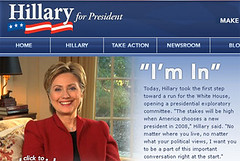
Hillary Clinton's website refers to her just as "Hillary" whenever possible and only uses "Clinton" where it is more or less necessary. "Rodham" is nowhere to be found.
Again, the official JFW position is not so much to endorse a particular candidate at this point as to anti-endorse whatever Democratic candidates Republicans are really enthusiastic about seeing win the nomination. While "Hillary" does not bring quite the same GOP glee as a second Kerry candidacy, it's close.
Sunday, January 07, 2007
you don't have to be an economist to see the problem...
"I am required by law to negotiate with you over the price of this car. I am also required, at the end of the day, to buy this car. I see that the sticker price is $23,000. How about we start the negotiations at $17,000?"
"How about we end the negotiations at $23,000?"
"Um, $19,000?"
"$23,000."
"The law says I have to buy this car! $21,000 is not my final offer!"
"$23,000."
"Okay, $23,000."
This, as far as I can tell, is what the Democrats are offering as their plan for how the government will use its "power" to negotiate lower prices for prescription drugs with Medicare. NYT has critics making the point here.
That said, my guess is the government will be able to negotiate lower prices, which will be partly apparent [lower prices compared to what?] and partly real, just so this plan can be called a success and there will be no pressure to enact a plan where the government has true leverage and could force a much stronger deal.
It's a little like invading a foreign country without enough troops to do the job properly, except that, over the long-term, more Americans will be killed by suboptimal drug policy than by the war in Iraq.
To clarify: (1) some negotiation can't be worse than the Republican plan allowing no negotiation, but (2) this is still much better from the perspective of the pharmaceutical industry than what the Democrats could have done. Given how much money the pharmaceutical industry spent trying to defeat Democrats, it does make one wonder if part of the purpose is to neutralize this lobby by being ungenerous but not unfriendly toward them.
"How about we end the negotiations at $23,000?"
"Um, $19,000?"
"$23,000."
"The law says I have to buy this car! $21,000 is not my final offer!"
"$23,000."
"Okay, $23,000."
This, as far as I can tell, is what the Democrats are offering as their plan for how the government will use its "power" to negotiate lower prices for prescription drugs with Medicare. NYT has critics making the point here.
That said, my guess is the government will be able to negotiate lower prices, which will be partly apparent [lower prices compared to what?] and partly real, just so this plan can be called a success and there will be no pressure to enact a plan where the government has true leverage and could force a much stronger deal.
It's a little like invading a foreign country without enough troops to do the job properly, except that, over the long-term, more Americans will be killed by suboptimal drug policy than by the war in Iraq.
To clarify: (1) some negotiation can't be worse than the Republican plan allowing no negotiation, but (2) this is still much better from the perspective of the pharmaceutical industry than what the Democrats could have done. Given how much money the pharmaceutical industry spent trying to defeat Democrats, it does make one wonder if part of the purpose is to neutralize this lobby by being ungenerous but not unfriendly toward them.
Sunday, July 18, 2004
barbs
So, public sociologists everywhere seem to be all excited about Barbara Ehrenreich's summer stint doing op-eds for NYT (examples here and here). These reactions are actually more mild than the utterly uniform glee I've heard from sociologists expressing their opinions about it in non-public forums. There have also been various cheerleaderly calls by journalists for Ehrenreich to be given a permanent position at the NYT.
Her column earlier this week was a celebration of the need to break free from pressures to conformity of thought. In the spirit of what she extols, I feel emboldened to say something to demonstrate my independence from those on basically The Same Political Side as myself: namely, I have found Ehrenreich's columns to be more annoying and alienating than anything else.
I know, I know, how dare I type something like that. I should be forced to go to confession and do ten Hate Bushes right away, or else be sentenced to permanent scarequotes around any leftward identification: that Jeremy, he's a "liberal."
If there is anyone else out there, anywhere, who (1) considers themselves on the left part of the political spectrum, (2) has been reading Ehrenreich's columns, and (3) does not finish them feeling awash in ideological self-satisfaction, I would certainly appreciately hearing from you, as independent thinkers aren't necessarily thrilled about being lonesome independent thinkers, especially when they don't get what everyone else is so enamored of.
In today's column, Ehrenreich disses Nader. Of course, she did vote for him in 2000. In Florida. You go, Barbara! It apparently wasn't until "well into the reign of Bush" that she figured out Bush was a sufficiently bad president that the Nader-for-2000 campaign came to seem like maybe it was a bad idea. She defends her 2000 vote for Nader in part because, before the election, Bush seemed like he would be a mostly harmless president. She's so perceptive!
If I seem surly about all this, the column of hers that really caused me to turn on the NYT Ehrenreich was the one on Bill Cosby. While I was not pleased with some of Cosby's recent remarks, in my mind he certainly didn't deserve this kind of treatment. He didn't deserve to be cast as Billionaire Bashing Poor Blacks without also noting his far-less-than-privileged background (granted, pretty much everyone has seen Fat Albert). He didn't deserve to make it sound like he's not also very critical of existing social policies. He didn't deserve to be lumped in as another example of those who "routinely excoriated poor black women for being lazy, promiscuous, government-dependent baby machines."
I mean, from where I'm sitting, if you ask me the question of who has done more for blacks in America: (a) Bill Cosby or (b) Barbara Ehrenreich, where for (b) you also throw in the whole of white public sociology since 1970, I'm still going with Cosby. So pardon me if I'm reticient to consign him to a Villain role in the professional-wrestling-melodrama of contemporary political discourse.*
Besides this, the main thing that bothers me about Ehrenreich is that I think that she's disingenuous, by which I mean she's willing to say things that she knows are misleading in order to score points for The Cause. Sure, there are all kinds of people on the right who do this, and, well, frankly, they annoy me even more, but you don't get off my annoyance hook just because you are arguing to a basic end I agree with. But, where this probably bothers me most is in some of the ways she cites statistics, but it's late and I don't want to get into that. At least until something else she writes sets me off.
For the sociologically-inclined readers, however, I can't resist taking note of this strangely old-school-functionalist and anthropologically dubious turn smack in the middle of the groupthink column from earlier this week:
*Google something like "Cosby remarks" and read various statement by Black critics of Cosby's remarks--setting aside the issue of the many Blacks who acclaimed them--and you can see how at variance Ehrenreich's reaction is from that of Black leaders on this issue. A more nasty person than myself might observe that, given that she's such a case of only-very-late-onset-Nader-voting-remorse, we probably shouldn't be surprised not to see much influence of Black perspectives on her views, even on Black issues, especially when an opportunity for posturing presents itself. That's pretty much Nader in a nutshell for the past decade. But I'll refrain from observing that, especially since this post has already seems so negative already. The Cosby column really irritated me and has been festering with each new column since. I'll try to come up with something light'n'chirpy for my next post.
Her column earlier this week was a celebration of the need to break free from pressures to conformity of thought. In the spirit of what she extols, I feel emboldened to say something to demonstrate my independence from those on basically The Same Political Side as myself: namely, I have found Ehrenreich's columns to be more annoying and alienating than anything else.
I know, I know, how dare I type something like that. I should be forced to go to confession and do ten Hate Bushes right away, or else be sentenced to permanent scarequotes around any leftward identification: that Jeremy, he's a "liberal."
If there is anyone else out there, anywhere, who (1) considers themselves on the left part of the political spectrum, (2) has been reading Ehrenreich's columns, and (3) does not finish them feeling awash in ideological self-satisfaction, I would certainly appreciately hearing from you, as independent thinkers aren't necessarily thrilled about being lonesome independent thinkers, especially when they don't get what everyone else is so enamored of.
In today's column, Ehrenreich disses Nader. Of course, she did vote for him in 2000. In Florida. You go, Barbara! It apparently wasn't until "well into the reign of Bush" that she figured out Bush was a sufficiently bad president that the Nader-for-2000 campaign came to seem like maybe it was a bad idea. She defends her 2000 vote for Nader in part because, before the election, Bush seemed like he would be a mostly harmless president. She's so perceptive!
If I seem surly about all this, the column of hers that really caused me to turn on the NYT Ehrenreich was the one on Bill Cosby. While I was not pleased with some of Cosby's recent remarks, in my mind he certainly didn't deserve this kind of treatment. He didn't deserve to be cast as Billionaire Bashing Poor Blacks without also noting his far-less-than-privileged background (granted, pretty much everyone has seen Fat Albert). He didn't deserve to make it sound like he's not also very critical of existing social policies. He didn't deserve to be lumped in as another example of those who "routinely excoriated poor black women for being lazy, promiscuous, government-dependent baby machines."
I mean, from where I'm sitting, if you ask me the question of who has done more for blacks in America: (a) Bill Cosby or (b) Barbara Ehrenreich, where for (b) you also throw in the whole of white public sociology since 1970, I'm still going with Cosby. So pardon me if I'm reticient to consign him to a Villain role in the professional-wrestling-melodrama of contemporary political discourse.*
Besides this, the main thing that bothers me about Ehrenreich is that I think that she's disingenuous, by which I mean she's willing to say things that she knows are misleading in order to score points for The Cause. Sure, there are all kinds of people on the right who do this, and, well, frankly, they annoy me even more, but you don't get off my annoyance hook just because you are arguing to a basic end I agree with. But, where this probably bothers me most is in some of the ways she cites statistics, but it's late and I don't want to get into that. At least until something else she writes sets me off.
For the sociologically-inclined readers, however, I can't resist taking note of this strangely old-school-functionalist and anthropologically dubious turn smack in the middle of the groupthink column from earlier this week:
"Societies throughout history have recognized the hazards of groupthink and made arrangements to guard against it. The shaman, the wise woman and similar figures all represent institutionalized outlets for alternative points of view. In the European carnival tradition, a 'king of fools' was permitted to mock the authorities, at least for a day or two. In some cultures, people resorted to vision quests or hallucinogens -- anything to get out of the box."Woo-hoo, wild characterizations of the origins of institutions in other societies as a way of making a political point for The Cause. You could use this paragraph as the running example for a short primer on the problems of functionalist social reasoning (especially the point that functions institutional arrangements might serve or come to serve are not, just by virtue of [here, even, rather dubiously] serving these functions, evidence that the functions explain the origins of the arrangements). We should draft a resolution for the American Sociological Association meetings to demand that the Times give us more!
*Google something like "Cosby remarks" and read various statement by Black critics of Cosby's remarks--setting aside the issue of the many Blacks who acclaimed them--and you can see how at variance Ehrenreich's reaction is from that of Black leaders on this issue. A more nasty person than myself might observe that, given that she's such a case of only-very-late-onset-Nader-voting-remorse, we probably shouldn't be surprised not to see much influence of Black perspectives on her views, even on Black issues, especially when an opportunity for posturing presents itself. That's pretty much Nader in a nutshell for the past decade. But I'll refrain from observing that, especially since this post has already seems so negative already. The Cosby column really irritated me and has been festering with each new column since. I'll try to come up with something light'n'chirpy for my next post.
Sunday, February 22, 2004
(politics) no longer mad at nader, continued
I have received some e-mail from friends expecting that I am going to be annoyed by the recent announcement that Ralph Nader will once again be mounting a Presidential campaign on behalf of George W. Bush. Readers may have forgotten my earlier pledge that I will henceforth confront my Nader issues with love. Granted, I have not been perfect in my efforts to live up to this pledge. However, I have confronted the most recent turn of developments with equanimity usually observed only in the highest echelon of lamas.
Among Nader's statements in announcing his candidacy, he said that those who were saying he should not run were making "a contemptuous statement against democracy, against freedom, against more voices and choices for the American people," and he also said that "it is an offense to deny the millions of people who might want to vote for our candidacy." The Old Me would have stomped around the RV in anger about the disingenuousness of this statement, and would have felt some need to expound at length the reasons why the statement is a manipulative distortion of various left ideals. Sure, the New Me may have typed three or four thousand words to this effect just now, but the New Me then lovingly hits the delete key rather than to post them. Hooray, New Me!
A sociologist of a different sort from your weblog author does display some bitterness and anger toward Nader in an article in Salon. While he (Todd Gitlin) makes all kinds of points The Old Me would applaud, the New Me appreciates his reasoning but still feels that I should send the Salon author an e-mail suggesting he should let go of the poison inside him like I have. Indeed, here goes:
The New Me sees no bile, however, in repeating a few sentences from Gitlin's essay regarding the argument that a national candidate can gain considerably by mobilizing turnout of new voters:
Among Nader's statements in announcing his candidacy, he said that those who were saying he should not run were making "a contemptuous statement against democracy, against freedom, against more voices and choices for the American people," and he also said that "it is an offense to deny the millions of people who might want to vote for our candidacy." The Old Me would have stomped around the RV in anger about the disingenuousness of this statement, and would have felt some need to expound at length the reasons why the statement is a manipulative distortion of various left ideals. Sure, the New Me may have typed three or four thousand words to this effect just now, but the New Me then lovingly hits the delete key rather than to post them. Hooray, New Me!
A sociologist of a different sort from your weblog author does display some bitterness and anger toward Nader in an article in Salon. While he (Todd Gitlin) makes all kinds of points The Old Me would applaud, the New Me appreciates his reasoning but still feels that I should send the Salon author an e-mail suggesting he should let go of the poison inside him like I have. Indeed, here goes:
Todd:Click and send. Granted, my half-sister Dahlia might be annoyed that I signed her name to the message instead of my own, but the New Me does not want to risk backsliding as the result of getting pulled into any colloquy regarding Nader.
I used to have the same kind of relentless and seething anger toward Nader for the 2000 election as you did. Through breathing exercises and grudge-reducing crystals, however, I have been gradually able to let this go. As a result, I would say that I now feel better--more free, more healthy, more connected with myself--than I ever could have imagined with a Republican in the White House. While I appreciate the eloquence with which you articulate your rage, I would urge you to work on your own Nader issues and to consider the possibility that some of the anger that you believe you feel toward Nader is really anger you feel toward, in Michael Jackson's words, the "Man in the Mirror."
Give Peace a Chance! Let Love In Your Heart!
The New Me sees no bile, however, in repeating a few sentences from Gitlin's essay regarding the argument that a national candidate can gain considerably by mobilizing turnout of new voters:
"if you take a hard look at the turnout argument, you see that the legions of nonvoters are the spectral cavalry of the marginals -- the phantasmagorical saviors waiting in the canyons. Nader invoked them in 2000. Howard Dean invoked them this year. They are an argument of last resort in political fantasies."
Saturday, February 21, 2004
(politics) crimes of electoral confusion, continued
From Salon.com:
Even some of Nader's closest progressive allies have their doubts. "I love and appreciate him, but I definitely want to get Bush out of office, so I won't vote for him, which would be a first for me," says Medea Benjamin, the Green Party candidate for U.S. Senate from California in 2000. She says it's good that Nader is not running as a Green Party candidate, because it will allow someone else within the organization to gain national attention as a presidential candidate.
Subscribe to:
Posts (Atom)