Okay, so keep in mind that the NRC ranking survey I posted about a few days ago not only doesn't allow you to include faculty size as a criterion for department quality, but also presumably the measures of faculty quality used will be based on averages. Averages are only fair, right? Otherwise, small departments would be at a disadvantage, and that's unfair because, well, it's, well, um, unfair.
The trouble with averages in a measure of department quality is simple: to use averages is to imply that half the members of a department do not merely contribute less to the quality of a department than their more productive/cited/grants-getting colleagues, but that they actively harm it. Take any department, fire the lesser half according to whatever the quality measure is, and you've instantly created a better department. You can even repeat the step and create an still better department, until you have a one-faculty member graduate program.*
I'm not sure how many faculty members are actively bad for the programs that employ them, in the sense that the program would better if they immediately disappeared and took their hiring line with them.** I feel confident, though, in my sense that this number is quite a bit less than half at most places. If you are in academia, think about your own department, and don't just single out the worst person, but think of somebody you think would probably be a little below the dividing line. Do you really think your department would be better if that person just vanished? They really hurt more than they help? Maybe so: but, if that's really true for half your department, I hope you aren't surprised by my response that your department must suck.
Average measures also imply that if you take a department and add to it by hiring everyone's structural equivalent, you haven't improved the department at all. Think graduate students are better off having four people in their specialty area rather than two? Average-based measures of quality imply no. In sociology, faculty size has always seemed to me especially an issue to attend to insofar as the discipline is sparsely populated even at the largest departments and many graduate students change their mind about the area they want to work in after they begin (or come in not knowing what they want to study). The smaller the department, the more likely a graduate student is to suffer from a change of interest, a falling out with their advisor, or their advisor leaving.
Not that I think faculty size should be the be-all-end-all, especially as one would expect it to be correlated with what Fabio calls programs of "benign neglect". I would rather program ratings try to measure benign neglect more directly, however. Anyway, if faculty size ends up having no weight or very little weight in the way NRC ultimately does the "objective" part of its rankings, that's just not credible.
* Half per se assumes either we are talking average in terms of the median or a measure that is symmetrically distributed. You know what I mean. My guess is there are ~40 sociologists who would be have the highest "faculty quality" of any department in the country if only they could get themselves into a department with no colleagues.
** Not that they left and someone else was rehired; there is a difference between someone being not the best use of a faculty line and being actively bad, and averages treat half the department as actively bad.
Addendum: I actually wrote this post a couple days ago, and in the interim Dan has written his own reaction to my earlier post. Incidentally, I suppose one could think it convenient that I have this strong opinion about faculty size while being a member of one of the largest sociology departments in the US. Maybe so. But it just seems intellectually galling to me that you'd have a rating system based on the idea that if there were two great small departments out there and you could somehow merge them, the result would be no better. It's one thing to say a whole isn't greater than the sum of its parts, and another to say the sum is no better than the average of its parts.
Showing posts with label rankings. Show all posts
Showing posts with label rankings. Show all posts
Friday, February 02, 2007


Tuesday, January 30, 2007
what makes graduate programs great?
I just did the general National Research Council survey of faculty for the sociology department rankings they are putting together. This survey asks questions about your own record (you also attach your vita), and then it also asks you questions about what you think are the criteria by which a graduate program should be judged. I thought these latter questions were interesting, and so saved them to repost here. There are separate questions about criteria for assessing (1) the quality of faculty, (2) the quality of students, and (3) general characteristics of programs, and then you are asked separately to provide the % by which you would weight each of those three categories toward a global rating.
For each category, you are asked to selected up to four categories you think are "important" and then the two you think are most important. I will italicize the two I selected as most important, but restrain myself from more discussion. Assessing graduate program quality is a matter about which I have many wheelbarrows full of thoughts, but I have way too much to do so I don't even want to get into that here.
BTW, I was surprised by the absence of faculty size as a criterion. I feel like small departments must have won some political/rhetorical battle for that to be something not even available as an alternative someone doing the ratings could choose.
BTW-BTW, if NRC conducted a survey of graduate student satisfaction/happiness, I would have selected this as a criterion that should be used. I have thought that ASA should organize an online survey on that as a service to the future of the profession. My experience is that when sociology faculty see unhappy graduate students in their midst, their response is first to remove their sociology thinking caps and then to say "there are unhappy graduate students everywhere," a statement that is no doubt true but doesn't really note the relevant and important possibility that the proportion of unhappy students may vary from place to place and perhaps some of this variation has to do with details of their program.
For each category, you are asked to selected up to four categories you think are "important" and then the two you think are most important. I will italicize the two I selected as most important, but restrain myself from more discussion. Assessing graduate program quality is a matter about which I have many wheelbarrows full of thoughts, but I have way too much to do so I don't even want to get into that here.
Regarding the quality of the program's faculty:Anyway, I'd be interested in how you would have answered these questions (or, if you're also faculty and have done the survey, how you did answer them). One of the things I kept thinking about as I did the survey is how I would have answered the questions if I'd done this survey as a graduate student vs. how I answered them now.
a. Number of publications (books, articles, etc.) per faculty member
b. Number of citations per faculty member
c. Receipt of extramural grants for research
d. Involvement in interdisciplinary work
e. Racial/ethnic diversity of the program faculty
f. Gender diversity of the program faculty
g. Reception by peers of a faculty member's work as measured by honors and awards
Regarding the quality of the program's students:
a. Median GRE scores of entering students
b. Percentage of students receiving full financial support
c. Percentage of students with portable fellowships
d. Number of student publications and presentations
e. Racial/ethnic diversity of the student population
f. Gender diversity of the student population
g. A high percentage of international students
Regarding the program:
a. Average number of Ph.D.s granted over the last five years
b. Percentage of entering students who complete a doctoral degree
c. Time to degree
d. Placement of students after graduation
e. Percentage of students with individual work space
f. Percentage of health insurance premiums covered by the institution or program
g. Number of student support activities provided at either the institutional or program level
BTW, I was surprised by the absence of faculty size as a criterion. I feel like small departments must have won some political/rhetorical battle for that to be something not even available as an alternative someone doing the ratings could choose.
BTW-BTW, if NRC conducted a survey of graduate student satisfaction/happiness, I would have selected this as a criterion that should be used. I have thought that ASA should organize an online survey on that as a service to the future of the profession. My experience is that when sociology faculty see unhappy graduate students in their midst, their response is first to remove their sociology thinking caps and then to say "there are unhappy graduate students everywhere," a statement that is no doubt true but doesn't really note the relevant and important possibility that the proportion of unhappy students may vary from place to place and perhaps some of this variation has to do with details of their program.
Friday, November 10, 2006
the social forces social
So, my post about the Notre Dame rankings and Social Forces and its follow up have gotten a lot of comments. I'm out of the discussion as a participant, but highlights of some others' observations:
1. Kim has posted rankings that are based on the Notre Dame group's methodology but drops Social Forces over at Marginal Utility. Why she doesn't send them to Footnotes, I don't know.
2. Dan Myers from Notre Dame has posted his opinion about the Notre Dame rankings.
3. I was told to "CHECK YOUR OWN BIASES!", in boldface no less, by showing skepticism to a ranking which ranks many departments ahead of my own, which is defensible given that my current cloaking of my blog from search engines prevents me from easily linking back to my several posts criticizing the US News & World Report ranking system that ranked my own department #1.
4. While Kim and Dan may feel they have valid points, I think we can all agree that this comment is the true voice of righteous sociology on these matters. Fight the power. Peace. Word. Dude. All we have to lose are our chains.
5. Somebody (and also this) pointed me last night to the Sociology Rumor Mill blog, which has lately taken up journal prestige in its thread as well. It's spawned a Wiki that is meant to summarize key information about the junior search market.
Update: Dan Myers has started a discussion board devoted to professional socialization issues.
Monday, November 06, 2006
big three, big whoop
Okay, so I'm really not interested in belaboring this, but in my recent post on the Notre Dame "productive faculty" rankings, some commenters have implied that I am ignorant about journal impact factors and that if I looked at them I would see what an obvious "Big 3" there were in sociology. I don't get what other people are looking at and, if people are going to hector me about being ignorant about evidence, I want to know what this evidence is. I pull up the ISI Web of Knowledge impact factors right now (note, not based on something somebody remembers reading sometime somewhere), and this is what I see:
(Note: I have problems of my own with journal impact factor measures anyway--although not nearly as large as the problems I have with the equation of citation counts with the merits of individual scholars.)
1 AM J SOCIOL - 3.262Just to be clear, this is only incidentally relevant to the point I was arguing, which was more about whether there was a "Big 3" or a "Big 2" followed by subfield-dependent ambiguity as to how SF was regarded relative to the top journal in that subarea. It's weird regardless how some people believe that if you question whether there is a "Big 3" or just a "Big 2," people think showing something is #3 is a knockdown counterargument. I am sure they would also argue that there are a "Big 3" of human sexes, alongside "male" and "female", if one type of intersexedness was demonstrably more common than others.
2 AM SOCIOL REV - 2.933
3 ANNU REV SOCIOL - 2.521
4 SOCIOL HEALTH ILL - 2.169
5 SOC PROBL - 1.796
6 SOC FORCES - 1.578
7 BRIT J SOCIOL - 1.490
8 LAW SOC REV - 1.396
9 SOC NETWORKS - 1.382
10 J MARRIAGE FAM - 1.350
(Note: I have problems of my own with journal impact factor measures anyway--although not nearly as large as the problems I have with the equation of citation counts with the merits of individual scholars.)
Saturday, November 04, 2006
sociologist, rank thyself!
So, apparently some people have repeated the exercise of providing rankings of the research productivity of sociology departments based on publications in the American Sociological Review, American Journal of Sociology, and Social Forces (via Chris). The authors appear to be from Notre Dame, which by the authors' methodology (e.g., the selected time window and counting affiliations by where authors are now as opposed to where they were when doing the article), comes out #5, far above its usual reputational ranking and well above where it was the last time productivity rankings were done, although then it was by a group at (my beloved) Iowa rather than at Notre Dame. I think Notre Dame has a number of great people, has made some extremely good recent hires, and is underrated by reputational rankings, but one of the curious things about these rankings is that they have a way of appearing just at the time and using just the criteria that manage to favor the department doing the rankings. When the Iowa group did the earlier rankings, they published a way of calculating them by which Iowa came out #1.
I'm all for departments promoting themselves, and I can understand where departments that feel like they have productive people and are collectively underappreciated would want to get the word out. But I don't much like the process of dressing it up like one is engaged in a dispassionate enterprise that just happens to produce results favoring one's home department.
Anyway, there are many obvious criticisms of using this as a general metric of departmental prestige or even department article-producing productivity, which the authors acknowledge (even if they plow ahead nonetheless). I want to offer an additional criticism the authors don't acknowledge: I want to see a defense of the concept that there is presently a "Big 3" of sociology journals. I think there is a "Big 2": ASR and AJS. Nobody in sociology confuses the prestige of a Social Forces with the prestige of an ASR or AJS. But the bigger problem with including Social Forces is that it's not obvious to me that Social Forces is the "next best home" for articles that don't make it into ASR or AJS. I think that much of that sociology right now is conducted in subareas for which the top journal in that subarea the most prestigious outlet after ASR and AJS, and then Social Forces comes somewhere after that. If that's true, then it really makes no sense to include it in rankings like this, as then there is all kinds of bias induced by whether work is in a subarea for which SF is the top outlet after ASR/AJS or not (e.g., ever noticed how many papers on religion appear in SF?).
I don't really mean to diss Social Forces--especially since, um, they could be getting a submission from me in the next few months--it's just that using them in these rankings raises two irresistable ironies. One is that the way the Notre Dame groups motivates their article is by the idea that reputational rankings of departments are fuzzy and history-laden so we should look to some hard-numbers criterion. Fine, then, I want to see a hard numbers criteria applied to establishing the prestige of the journals included, as then otherwise the authors are just using the same kind of fuzzy history-laden reputational reasoning for journals that they see as problematic in departments. The other is that, even though in the best case scenario, Social Forces is the clear third of the "Big 3", yet it publishes more articles than either AJS or ASR, so it actually ends up counting the most in these rankings.
For the record, I'm not much into prestige rankings for either departments or journals. Indeed, it's for that reason that I think when rankings are offered, they warrant some scrutiny.
Monday, April 04, 2005
still another post about the sociology rankings
Word is that a few graduate students here are upset about the US News ranking Wisconsin Sociology #1. Or, at least, they are bothered by the upbeat comments that our chair made in response to a local media query about the rankings. Apparently, she was supposed to talk about how some of our recent faculty losses make the ranking undeserved and, moreover, what we actually practice here is a systematic reign of cruelty over our students. Or something like that. Maybe The Truly Discontented around here will get together and write a letter to US News about the horrors of the department at the top of their sociology list. That would make for some good academic theater for the months before I'm headed off to my exile to Harvard.
Truthfully, at least a couple of my colleagues have expressed surprise that Wisconsin has remained #1 despite some of the losses we've had. News of losses, of course, spreads slowly and incompletely, and, besides, at least one apparent departure happened after the survey was in. That said, at least from my recollection of scores in the last rankings, the change from the previous Wisconsin-Berkeley tie to the present Wisconsin #1 outright is not a matter of Wisconsin's score going up, but Berkeley's score going down. For which, a plausible suspect can be named in three words: Public Sociology backlash. As I discussed in my last post, the top of the rankings are determined more by avoiding dis-adoration than by culling especial reverence, and, whatever you think of the public sociology omelet, it wasn't made without breaking some eggs.
In any case, at least if you look at the Berkeley website, being the premier home of "public sociology" seems to be taking over the vision of that department, or at least its graduate program. Which is all well and good until you remember that Burawoy's formulation of "public" sociology sets it apart from "policy" and "professional" sociology (not to say that Berkeley doesn't offer opportunities for "policy" or "professional" sociology, of course; but, in my opinion, their website makes them look narrower than they are). I was talking to somebody recently who visited Berkeley's Visit Day this spring as a prospective student. I asked him if they did a lot of talking about "public sociology", and he said they did, but then he mentioned that it would have been more helpful if someone had explained what "public sociology" was. Wow: leave it to sociology to turn even its banner phrase for engaging the public sphere into a matter of insular jargon.
In any case, one of the things about this place that drives me to despair is when students complain about this department being "narrow." Not having more faculty members doing what you specifically would like does not make a department "narrow." Whatever you want to say about other vectors of "quality" of a graduate program, Wisconsin has been, over the last five years, the most intellectually diverse of the top departments. Don't believe me? Here's a test: go to Dissertation Abstracts and get the titles of the last 25 Ph.D.'s defended at each of the top departments. Make a list of titles for each department that removes their names ("Department A", "Department B"). Show them to a few people who are not sociologists and ask them to rank the lists in terms of which seems the most diverse. My guess: Wisconsin wins hands down.
Sunday, April 03, 2005
what does it mean to be the top ranked sociology department, anyway?
Or, at least, how is it that the US News & World Report generates the ranking that has Wisconsin #1 and Berkeley #2?
As enthusiastic as I am to see Wisconsin at the top of the rankings, I would be lying if I said I thought that the US News methodology of rankings was particularly sound. It's plainly inferior, for example, to the methods that are used by news services to rank college sports teams.
Here's how it works: the chairs and directors of graduate studies of active Ph.D. granting programs (averaging at least one Ph.D. a year over the past five years) are given a survey. The ultimate response rates for the survey are low--about 50% of the sociology surveys were returned, which was actually the highest rate among all the Social Sciences & Humanities (less than a quarter of the psychology surveys were returned). I don't regard the low response rates as a problem, as my guess would be that there is a substantial correlation between not sending back the survey and being relatively uninformed about other departments and graduate programs. (That said, it seems very much an open question about whether anybody is really in a great position to know that much about very many other graduate programs, and so whether 'expert polling' can ultimately produce rankings with that much validity.)
The survey basically lists all the departments with Ph.D. programs in alphabetical order and asks respondents to rate each program on a scale of 1-5 (5=outstanding, 4=strong, 3=good, 2=adequate, or 1=marginal). To reduce the capacity of a single rogue voter to game the rankings, US News throws out the two highest and two lowest scores for each school, and then takes the average. The rankings are just the ordering of these average scores, with the additional weird twist that US News will regard two schools as tied if their averages are equal when rounded to the tenths digit. (In other words, while two schools with averages 4.86 and 4.84 are not considered tied, two schools with averages 4.84 and 4.76 are considered tied).
The problem with using this scheme to make distinctions among top-ranked departments is that only a minority of respondents end up casting the votes that make the ultimate difference in which department is top-ranked. Wisconsin is reported as having a 4.9 average, while Berkeley's average is 4.8. If we presume that no more than two people would be so ridiculous as to give either department a 3, what this implies is that somewhere between 5-15% of people gave Wisconsin a 4, while somewhere between 15-25% of people gave Berkeley a 4. The majority of respondents (somewhere between 60-90%) gave Wisconsin and Berkeley the same rating.
It could be, then, that if you had people specifically rank the top departments, a majority of respondents would have put Berkeley ahead of Madison. Indeed, if you had respondents rank departments and then determined The Number One Department using a system like the Instant Run-Off Voting System advocated by the Greens, it's mathematically possible that any of the departments with ratings of 4.3 of above (Wisconsin, Berkeley, Michigan, Chicago, North Carolina, Princeton, Stanford, Harvard, UCLA) could be the winner, although scenarios become increasingly implausible as you move down the list. The larger point, though, is that the relative difference between Wisconsin and Berkeley in the rankings is generated by the 10-40% who regard the difference between the two departments as enough to give one a 5 and the other a 4, and not at all by the 60-90% who thought the departments deserved the same rating on a 1-5 scale but who could still have definite opinions on which program is better.
This isn't to say Wisconsin wouldn't be #1 under an alternative and better set of rankings--I have no way of knowing--it's just to say that Wisconsin's ranking shouldn't be interpreted as meaning something more or different than it does.
Incidentally, the US News specialty rankings are done entirely differently. Respondents are asked merely to list (but not rank) up to ten departments that they regard as distinguished in that speciality. US News counts up how many respondents list each school and these counts provide the basis for the ranking. I think US News must do it this way because they recognize the limited knowledge chairs and DGSes must have of specialities outside their own. Anyway, this means that the specialty rankings are essentially a sort of like a gauge of the overall name recognition that a school has for a particular area. Presumably, in terms of what departments are ranked first vs. second in a specialty, the rankings are entirely a measure of the % of respondents who didn't think to include a school on their list, and doesn't at all reflect whatever relative opinions about the two programs are held by the vast majority of respondents who included both on their lists. (Also, my understanding is that there is no equivalent of throwing out the two lowest scores for the specialty rankings, so they are more vulnerable to being gamed by respondents leaving peer departments in a specialty off their lists.)
Saturday, April 02, 2005
more on the sociology rankings
From the US News & World Report rankings of graduate schools, here are the rankings of departments for the subspecialty "Sex & Gender" in sociology:
Update, noon: On campus, I decided to feed my internet addiction by checking the above proposition. In all of the Social Sciences rankings (49 different rankings in History, Political Science, English, Psychology, Criminology, Sociology, and Economics), the only set of rankings besides Sex & Gender not to include a single Ivy league school was "Industrial and Organizational Psychology", and there only 10 schools were ranked instead of 20.
1. University of California–BerkeleyAs my colleague Myra Ferree pointed out to me this morning, it is especially interesting to note in light of the whole l'affaire L'Summers that there isn't a single Ivy League school in the rankings. I wonder if there how many other subspecialties there are in any discipline where you can have rankings that list *20* departments and still not include any Ivies. If my laptop battery wasn't so low here at Borders, I would research this further.
2. University of California–Santa Barbara
3. University of Wisconsin–Madison
4. University of Washington
5. University of Michigan–Ann Arbor
6. Stanford University (CA)
University of Southern California
8. University of Maryland–College Park
9. Indiana University–Bloomington
10. Florida State University
New York University
University of California–Los Angeles
13. Northwestern University (IL)
SUNY–Albany
University of Massachusetts–Amherst
16. CUNY Graduate School and University Center
University of Texas–Austin
18. North Carolina State University
Rutgers State University–New Brunswick (NJ)
University of Minnesota–Twin Cities
Update, noon: On campus, I decided to feed my internet addiction by checking the above proposition. In all of the Social Sciences rankings (49 different rankings in History, Political Science, English, Psychology, Criminology, Sociology, and Economics), the only set of rankings besides Sex & Gender not to include a single Ivy league school was "Industrial and Organizational Psychology", and there only 10 schools were ranked instead of 20.
Thursday, March 31, 2005
take that, berkelosers!
The new US News & World Report rankings are out:
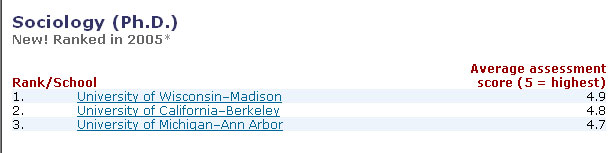
In a fit of truly irrational exuberance, I paid the $15 for the complete rankings. Wisconsin is ranked 1st in Sociology of Population and 1st in Social Stratification. We are also ranked 3rd (tied with Cornell) in Economic Sociology, 3rd in Sex and Gender, and 5th (tied with Arizona) in Social Psychology.
Presumably, in the days ahead, there will be much speculation among the sociological cognoscenti about how Madison managed, despite some serious faculty losses, to move from a tie with Berkeley in the previous rankings to now being top-ranked outright. Whatever else you want to say in comparing the two departments, Madison Sociology's massive blogging edge should not go unnoticed--the sconnies press ahead where other blogs have faltered. I'm sure that must be it.
Subscribe to:
Posts (Atom)