Leona Helmsley, who allegedly once told her housekeeper "Only the little people pay taxes," has left $12 million dollars to her Maltese, which works out to $2 million more than the sum of what she gave to the four children of her previously deceased son.
Speaking of doggy discrimination, I was on the bus the other day when the driver refused to let this woman with cerise hair on with her pit bull. As he closed the door, he said to the passengers nearest to the front--a woman with three children who had been let on, no questions asked--that "A chihuahua, fine. One of those things, no way." Where are the symbolic interactionist criminologists to consider whether part of why pit bulls are so violent is the way they get "labeled" by social authorities?
Showing posts with label pets. Show all posts
Showing posts with label pets. Show all posts
Wednesday, August 29, 2007


Friday, August 03, 2007
sex, lies, dogfighting, and videotape
Somebody asked me if I was ever going to write a post about the Michael Vick dogfighting scandal, given my ongoing dilettantish interest in Animals and Society. But a NYT column today seems to have it right:
I do think it's interesting that there are all kinds of ways that a football player could murder someone and have a much greater chance for public redemption than Michael Vick has. I think what makes the Vick crime so hard to imagine forgiveness is not just how much people love their dogs, but the way the scope and duration of the operation he bankrolled seems to bespeak a fundamental rottenness of core character, not the kind of thing to be resolved with a tearful televised apology or some anger management classes. Or jail time, I suspect.
Also: speaking of crimes that are unquestionably "bad" but ambiguous exactly "how bad" in the eyes of society, word from Madison a few weeks ago was that the neighbor of a friend of mine was arrested for having secretly videotaped himself having sex with women he was dating over the past five years (with no intent to distribute; the tapes were found in connection with a police search for other reasons). I think he was a graduate student--just so we're clear, not in sociology--and, according to the news story, he certainly gave the arresting officers a graduate student-ly explanation of his actions:
“I think we are a forgiving people and a sports-loving people,” Lapchick said. “We have the potential to forgive a lot of athletes who do stupid things, or at least the sports they play.”It's perhaps one of the more valuable criminal prosecutions in recent memory, as it has provided an unambiguous signal throughout American society regarding public sentiment for a crime about which there was otherwise much ambiguity. I take as the main evidence of ambiguity that companies with which Vick had endorsement deals at first weren't sure how to handle the situation, and now they can't get far enough away from him. I'm usually skeptical of the deterrent effect of "make an example of him" prosecutions, but I conjecture that this will have a real deterrent effect on dogfighting going forward.
But, he added, “I don’t think society is going to forgive Michael Vick, unless the charges prove wrong.”
I do think it's interesting that there are all kinds of ways that a football player could murder someone and have a much greater chance for public redemption than Michael Vick has. I think what makes the Vick crime so hard to imagine forgiveness is not just how much people love their dogs, but the way the scope and duration of the operation he bankrolled seems to bespeak a fundamental rottenness of core character, not the kind of thing to be resolved with a tearful televised apology or some anger management classes. Or jail time, I suspect.
Also: speaking of crimes that are unquestionably "bad" but ambiguous exactly "how bad" in the eyes of society, word from Madison a few weeks ago was that the neighbor of a friend of mine was arrested for having secretly videotaped himself having sex with women he was dating over the past five years (with no intent to distribute; the tapes were found in connection with a police search for other reasons). I think he was a graduate student--just so we're clear, not in sociology--and, according to the news story, he certainly gave the arresting officers a graduate student-ly explanation of his actions:
"It's funny, I never thought about asking anybody (for permission)," the complaint says he told police. "It stems from a sense of impermanence of relationships. ... I have the feeling like they aren't going to last. It lends itself to making the videotapes. The emotional need I have is to have a record."(And saving letters and gifts apparently just wasn't enough.) His court date was set for July 30, but there hasn't been any follow-up story in the paper about what happened. I wanted to see what kind of punishment somebody would get for this crime, as I'll admit I genuinely don't know what I think an appropriate sentence would be. Interestingly, the maximum possible sentence for his crime is a jail sentence nine times longer than the maximum sentence possible for Michael Vick (45 years versus 6).
Sunday, July 29, 2007
the far eastern front in the war to shrink the pet-child gap
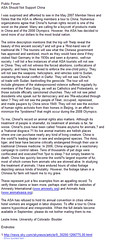
The sociologist who wrote the article on "Animal Selves" that I highlighted here a couple weeks ago has written a letter to ASA protesting their plan to offer a tour to China (I couldn't find the link, so I've pasted as jpg above). Me, I'll admit I don't understand how ASA's tour business works and so don't know what I think of the enterprise generally. I guess if ASA is going to be in the tour business, I wouldn't agree with them letting the political views of some members prevent other members who want to go on the tour.* (I presume the substantive importance of China to those interested in global society is without question, as is China's dismal human rights record.)
Anyway, the protest is made on both human and animal rights grounds. Comparisons are made to Nazi Germany and to ASA's decision to hold its meetings in Montreal. China is said to be "bankrolling genocide." Even so, "Although [China's] treatment of people is shameful, its treatment of animals is far, far worse." That said, by my tally, description of human rights abuses does edge out animal rights abuses, by a word count of 141-139.
BTW, according to a post on this site, eating dogs was banned in South Korea in 1988 just before the Olympics, but is presently legal in China (but not Taiwan or Hong Kong). I wonder if China will ban eating dogs before the 2008 Olympics open.
* I might feel differently if, say, ASA were talking about holding its annual meetings in China, although there would be nonhumanitarian grounds for complaining about that decision as well.
Sunday, July 15, 2007
what's jeremy's beef with the animals & society section?
Regarding my recent post about a sociological article against "speciesism," someone asked why I seem to be regularly chiding those sociologists involved with the Animals & Society section. Reason #1 is that a certain friend who doesn't have a blog of her own keeps sending me these things, so things are brought to my attention more than they otherwise might. Reason #2, point blank, is that I have no enthusiasm for the fight against "speciesism" and reject approximately all of its attendant moral arguments*, and so I have a hard time seeing it listed alongside "racism" and "war" on the roster of social concern.
But, beyond that:
I think if I had to name what I regarded as the most genuinely interesting social trends in the US in the last 50 years, the shrinking pet-child gap would maybe make the Top 10 and would certainly make the Top 20. "Interesting"-ness is in the eye of the beholder, of course, and I suspect the shrinking pet-child gap particularly intrigues me because I grew up on a farm, in a culture with a very different attitude toward animals than the world I stepped into when I entered graduate school. Indeed, when I was in graduate school, for awhile I was keeping this tally for the sociology graduate student listserv of the number of times anyone sent out a message related to advocacy for an animal welfare cause versus a message related to advocacy for a child welfare cause. My recollection is that the score ended up Pets 11, Kids 4.
This, to me, is interesting, but apparently not interesting enough where it has risen to being anything I actually do research about. Which is another reason that I find sociology's animal movement interesting, because it exemplifies for me a larger point about sociology. As I said, I believe the shrinking pet-child gap is an interesting phenomenon, and it could be subject to a extremely interesting analysis from somebody willing to take a broad and engaged-while-still-somewhat-removed view of it. But, of course, who is going to do that?
Instead, the people who are going to enter the field of "animals and society" are going to be the people who are most committed to fighting speciesism as a cause--in other words, the people who are playing a vanguard part in the very thing I regard as the phenomenon. So, instead of sociologists offering studies that help to understand the shrinking pet-child gap--which, whatever you think of it, is an empirical phenomenon with all sorts of social ramifications, we get sociologists exhibiting the phenomenon by arguing for the value of work in which the researcher studies playing with his dog and in which the researcher tries to use sociological theory to justify a polemic that elevates "speciesism" to being of a piece with racism.
* Even so, inexplicably, I must confess that I've been lately thinking about returning to pescatarianism (that is, eating no meat except for seafood).
But, beyond that:
I think if I had to name what I regarded as the most genuinely interesting social trends in the US in the last 50 years, the shrinking pet-child gap would maybe make the Top 10 and would certainly make the Top 20. "Interesting"-ness is in the eye of the beholder, of course, and I suspect the shrinking pet-child gap particularly intrigues me because I grew up on a farm, in a culture with a very different attitude toward animals than the world I stepped into when I entered graduate school. Indeed, when I was in graduate school, for awhile I was keeping this tally for the sociology graduate student listserv of the number of times anyone sent out a message related to advocacy for an animal welfare cause versus a message related to advocacy for a child welfare cause. My recollection is that the score ended up Pets 11, Kids 4.
This, to me, is interesting, but apparently not interesting enough where it has risen to being anything I actually do research about. Which is another reason that I find sociology's animal movement interesting, because it exemplifies for me a larger point about sociology. As I said, I believe the shrinking pet-child gap is an interesting phenomenon, and it could be subject to a extremely interesting analysis from somebody willing to take a broad and engaged-while-still-somewhat-removed view of it. But, of course, who is going to do that?
Instead, the people who are going to enter the field of "animals and society" are going to be the people who are most committed to fighting speciesism as a cause--in other words, the people who are playing a vanguard part in the very thing I regard as the phenomenon. So, instead of sociologists offering studies that help to understand the shrinking pet-child gap--which, whatever you think of it, is an empirical phenomenon with all sorts of social ramifications, we get sociologists exhibiting the phenomenon by arguing for the value of work in which the researcher studies playing with his dog and in which the researcher tries to use sociological theory to justify a polemic that elevates "speciesism" to being of a piece with racism.
* Even so, inexplicably, I must confess that I've been lately thinking about returning to pescatarianism (that is, eating no meat except for seafood).
Friday, July 13, 2007
chew on this
Qualitative Sociological Review has a special issue on "Animals and People." The lead article is "The question of animal selves: Implications for sociological knowledge and practice" from a sociologist at the University of Colorado. Concluding sentence of abstract:
(Granted, I'm having trouble figuring out what exactly "analytic sociology" is supposed to be, and I'm currently floundering while trying to write an essay for an edited volume on that.)
[S]ociologists have an obligation to challenge speciesism as part of a larger system of oppression.Some sentences from the conclusion of the paper:
Poverty, environmental degradation, homelessness, war, and the threat of terrorism are all high on the social agenda. Some would argue that they are more pressing than the well-being of animals. The flaw in this argument is that all problems are connected, and the segmenting of issues is both illogical and morally questionable. For example, the moral status of animals as property justifies institutionalized cruelty on the basis that we humans can use them as we see fit. The ideology of superiority, coupled with “might makes right,” also underpins sexism, racism, and homophobia.While various other things might be said, I will admit to having reached a point of confusion regarding exactly what qualitative sociology is.
(Granted, I'm having trouble figuring out what exactly "analytic sociology" is supposed to be, and I'm currently floundering while trying to write an essay for an edited volume on that.)
Saturday, February 24, 2007
impossible! my fatal would never hurt anyone!
From AP:
Authorities say a pit bull named Fatal attacked an Orlando boy after jumping through a car window.I recognize that I am on the wrong side of both contemporary thought and, even more assuredly, history with this--where, projecting ahead from trends in the peoplefication of pets, mature pit bulls will be granted the right to vote in the year 2048--but, if I were King Of The World, ordinary citizens would not be allowed to own pit bulls except perhaps through an elaborate screening and licensing procedure that would exclude anyone intending to name their dog "Fatal."
The 11-year-old boy was taken to the hospital yesterday with bites and cuts on his legs. Fatal, the dog, was taken to the pound. Animal control officers will decide what happens next with him.
Tuesday, January 09, 2007
dispatch from the ongoing battle between children in poverty vs. rich people's pets: rover scores again!
From the AP:
SARASOTA, Fla. --Austin ricochets around the Ritz-Carlton hotel room, bouncing from bed to chair and leaping high to lick the face of his personal masseuse. He's an energetic 4-year-old pug, so there is a lot of wriggling as his "privileged pup" pet massage begins. But soon his eyelids droop and his tiny muscles relax under the soothing touch of Darlene Davison, the Ritz-Carlton Sarasota's spa director.If only some organization teamed up with the Ritz-Carlton so that for every $130 dog massage, $1 went to help fight childhood malaria in Africa. 50 cents? A quarter?
"OK, sweetheart, OK. There you go," coos Davison, creator of the luxury hotel chain's latest indulgence -- the $130 dog massage.
Figure in the hotel's 20-pound weight limit and the additional $125 nonrefundable pet fee and the "privileged pup" plan comes out to a minimum of $12.75 a pound. And that's the basic package.
For another $220, the Ritz throws in gourmet dog biscuits, an in-room pet massage, a choice of nail buffing or nail polish, a souvenir photo, a brisk walk over Sarasota's scenic Ringling Bridge and a gourmet meal of organic stew and designer water served on a silver tray.
Subscribe to:
Posts (Atom)